
News
Hostile Architecture vs. Democratic Design for the Future
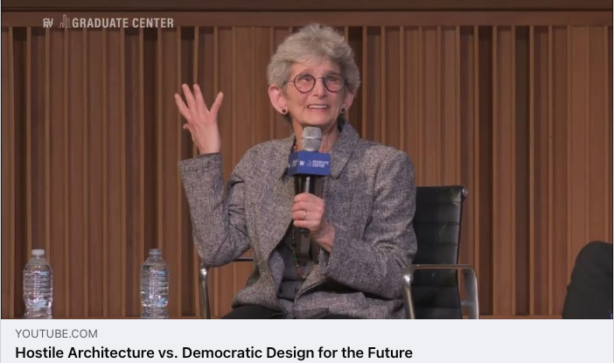
Many new buildings and public spaces in New York City have been criticized for being hostile to the public. In fact, “hostile architecture” is a term used by the media to describe an increasing feature in public spaces; for example, benches with multiple arms to deter sleeping and limit use by homeless people. How can city spaces be more democratic and inclusive, while also providing public safety? A panel of experts discusses the design of new developments, parks, plazas, and buildings, analyzing successes and failures, with an eye towards what the public should demand in the future.
This panel from May 13, 2026, featured Marta Gutman, dean and professor at the Spitzer School of Architecture at The City College of New York; Jerome Haferd, assistant professor at the Spitzer School of Architecture at The City College of New York; Anna Kodé, an award-winning features reporter with The New York Times, where she covers the built environment; Setha Low, distinguished professor of Psychology, Anthropology, Earth and Environmental Sciences, and Women’s and Gender Studies at the CUNY Graduate Center; and Tamar Renaud, the New York State director at Trust for Public Land.
Presented with the Ph.D. Program in Anthropology, the Ph.D. Program in Earth and Environmental Sciences, the Public Space Research Group, and the Bernard and Anne Spitzer School of Architecture at The City College of New York.
For more information about CUNY Graduate Center events, visit: http://www.gc.cuny.edu/public-programs.
Watch the full panel: