

News
J. Max Bond Center receives Sloan Foundation grant for creation of affordable housing, data-driven tool
-
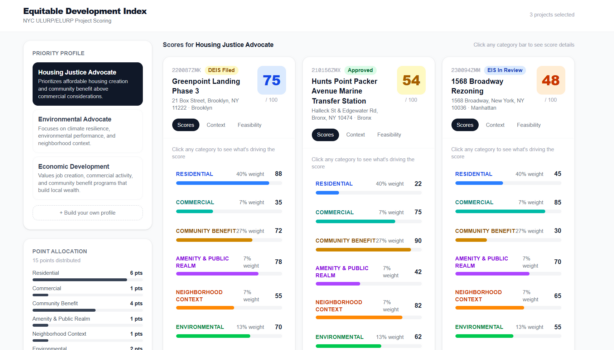
Image of the current Equitable Development Index prototype showing the scores of three different development projects that have been weighted to prioritize affordable housing and community benefit.
-
The Alfred P. Sloan Foundation awarded The City College of New York’s J. Max Bond Center for Urban Futures, at the Bernard and Anne Spitzer School of Architecture, a $355,550 grant for a project titled “The Equitable Development Index.” EDI aims to create a data-driven, decision-support tool to strengthen transparency, equity, and shared governance in New York City’s housing and land-use review process.
Shawn Rickenbacker, director of the J. Max Bond Center and associate professor, is the principal investigator of the project. Alden Copley, senior researcher at the J. Max Bond Center, and Lizzie MacWillie, assistant director of the J. Max Bond Center, are both co-PIs.
“Supported by the Alfred P. Sloan Foundation, we are putting to use the untapped potential of existing citywide real estate development data and offering new civic infrastructure to help solve New York City’s housing and equity challenges,” said Rickenbacker. “By providing diverse stakeholders with a transparent, data-driven tool, we are demonstrating that urban crises have achievable solutions through common knowledge and interest. This initiative elevates the value of civic participation, transforming urban growth into a shared achievement. We invite those interested in the future of urban innovation to join our effort.”
The EDI leverages unique user real estate development priorities coupled with advanced AI and Large Language Models (LLMs) to transform over a decade of fragmented public data into a powerful, data-driven, decision-support tool focused on more equitable development outcomes for New York City’s future.
The principal source of this fragmented data is Environmental Impact Statements (EIS), which are required for new developments seeking land use and zoning exceptions. These contain vital data on housing, density, and economic impact. However, their sheer density and technical scope have historically rendered them inaccessible to decision-makers throughout the development review and approval process. By synthesizing the data in these EIS documents, incorporating community data and comparing it to user-generated priority profiles, the EDI will provide community boards, city agencies, citizens and elected officials with rankings which reflect their own concerns about development for proposed land use and zoning exceptions.
This shift democratizes urban data and planning by reducing the accessibility gap, increasing the procedural efficiency of a complex and costly process, while reestablishing negotiations between decision-makers and developers from anecdotal debate to verified data-driven discourse. Stakeholders will be able to evaluate project trade-offs between affordability, community investment, displacement risk, and public benefit, ensuring that NYC’s growth is as equitable as it is innovative.
“As New York looks to remove obstacles to building more affordable housing, a public-facing, data-driven tool like EDI is primed to have significant impact,” said Joshua M. Greenberg, program director at the Alfred P. Sloan Foundation. “At the same time, the Bond Center’s community-centered approach also aligns with the Sloan Foundation’s history of supporting efforts to democratize data access to inform local decision-making.”
For more information, contact Shawn Rickenbacker at srickenbacker@ccny.cuny.edu.
About the Alfred P. Sloan Foundation
The Alfred P. Sloan Foundation is a not-for-profit, mission-driven grantmaking institution dedicated to improving the welfare of all through the advancement of scientific knowledge. Established in 1934 by Alfred Pritchard Sloan Jr., then-President and Chief Executive Officer of the General Motors Corporation, the Foundation makes grants in four broad areas: direct support of research in science, technology, engineering, mathematics, and economics; initiatives to increase access and opportunity in graduate science education; projects to develop or leverage technology to empower research; and efforts to enhance and deepen public engagement with science and scientists. sloan.org | @SloanFoundation
p: 212.650.6460